"I've been through this before with y'all, and I knew this was where we would end up. And here we are."
That's what District 6 Councilmember Alex Wan told the Atlanta City Council on September 8, 2026, just before members voted 11-4 to file the Peachtree Circle historic district proposal, ending a year-long fight in Ansley Park. If you've watched this play out on Nextdoor, at APCA meetings, or in the Ansleyphile, the ending probably doesn't surprise you. What might surprise you is what actually killed it.
It wasn't the merits. On the merits, this proposal won every single time it was tested.
The proposal that kept passing
Walk the procedural record and you won't find a single body that reviewed the Peachtree Circle historic district on planning grounds and said no. The Ansley Park Civic Association's own zoning committee found the proposal consistent with the neighborhood's master plan on July 27. Neighborhood Planning Unit E recommended it on August 4. The city's Zoning Review Board approved it 6-0 on August 6, with city staff testifying that current zoning lets developers tear down a house, rebuild at the front setback line, and break the rhythm of a street that Frederick Law Olmsted's design firm helped lay out. Even ZRB member Lauren Welsh, who said she was torn on the street-by-street approach, voted yes.
Every technical gatekeeper Atlanta has for this kind of question said the same thing: approve it.
Then it reached the City Council's own zoning committee in late August, and the math changed. Not the planning math. The politics.
The number that actually decided it
Here's the arithmetic nobody put in one sentence: Peachtree Circle has 72 parcels. As of the council vote, 40 of those owners supported the historic district. That's about 56 percent, a clear majority.
Wan didn't ask for a majority. He asked for a supermajority, roughly two-thirds, which on 72 parcels means around 48 owners. Proponents were eight owners short.
Here's the part worth sitting with: that two-thirds bar isn't in Atlanta's zoning code. Wan said so himself, on the record, when he described it as "not a legislative requirement. Just a standard that I have been using with my neighborhoods." It's a personal threshold he's applied to Ansley Park for more than a decade, not a rule any ordinance requires him to enforce.
So the proposal that cleared APCA, NPU-E, and the ZRB with unanimous or near-unanimous votes died in front of the one body whose bar had never been written down.
The third attempt in sixteen years
This wasn't Ansley Park's first swing at historic protection, and understanding why makes the current outcome land differently. Wan told the council that at least three attempts have been made to create a historic district in Ansley Park since he took office in 2010. Two of those covered the entire neighborhood. Both failed. The most recent full-neighborhood attempt collapsed in 2022 after a property rights advocate sued the civic association, a lawsuit that led four APCA board members to resign.
Peachtree Circle residents tried a narrower version this time, a single street instead of the whole neighborhood, hoping a smaller footprint would clear the same political hurdle that had sunk two previous efforts. It cleared every planning hurdle. It hit the same political ceiling anyway.
Councilmember Michael Julian Bond asked during the council debate whether historic zoning could apply only to the parcels whose owners actually wanted it, rather than the whole street. That question didn't get resolved before the vote to file, but it points at something worth remembering next time this comes up: the debate in Atlanta has never really been about whether these homes are architecturally significant. Robert Reed, director of the city's Historic Preservation Studio, put it plainly during the process: houses get torn down and rebuilt at the maximum allowed setback, interrupting the pattern of the street, and an ordinance exists specifically to address that. The disagreement is entirely about consent thresholds and who gets to set them.
What's actually protecting Peachtree Circle right now
If the collective approach keeps stalling on an unwritten supermajority rule, it's worth asking what has actually worked in Ansley Park. The answer is narrower than most residents probably assume: individual landmark designation, pursued one house at a time.
The clearest example sits right on Peachtree Circle. The Randolph-Lucas-Jones House, a 1924 Georgian Revival originally built near the intersection of Peachtree Road and Lindbergh Drive, was slated for demolition in 2013 before owners Roger Smith and the late Christopher M. Jones bought it, cut it into sections, and moved it two miles to an empty lot in Ansley Park. It lost its landmark status in the move and didn't get it back until 2025, when the city re-designated it, making it the first house in Ansley Park to hold that protection. Smith called it a turning point. It's also, as of today, still the only one.
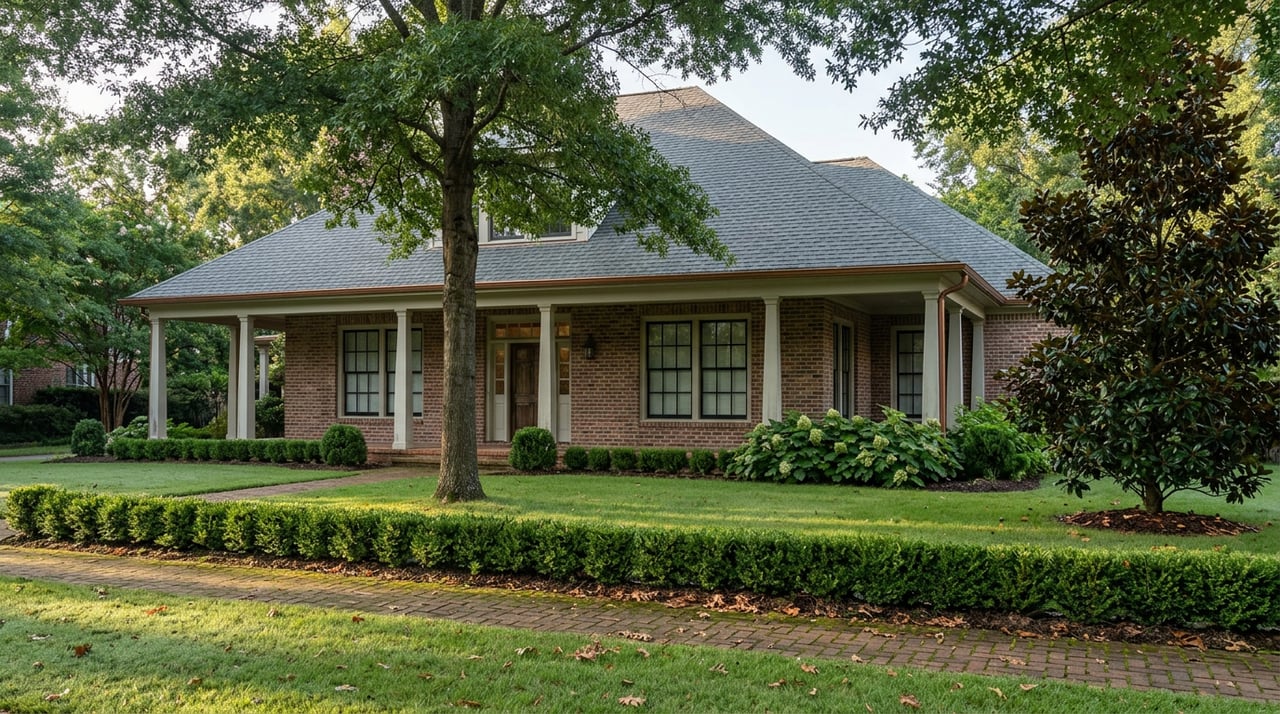
Contrast that with 205 Peachtree Circle, an American Craftsman home that had stood for more than a century on an acre-plus lot. The city approved a demolition permit for it before any moratorium was in place, and the new owners razed it in January 2026 to build a larger house. That demolition is the specific event that restarted the historic district push. No individual landmark application had been filed for that house. Nothing in the National Register listing Ansley Park has held since 1979 could have stopped it, since that designation prevents nothing at the level of an individual permit.
So the honest picture, as of September 2026, is this: Ansley Park's National Register listing is symbolic. Its historic district effort, which would have carried actual teeth, has now failed three times. The one mechanism that has demonstrably worked is a homeowner deciding, on their own initiative and at their own expense, to seek individual landmark status for their specific address. That's a fundamentally different proposition than a neighborhood-wide ordinance, and it means protection here depends far more on who owns a given house than on which street it sits on.
What actually changes now
Wan left the door open, telling the council he'd bring the legislation back if proponents reach that same two-thirds supermajority before it comes up again. That's a real path, not a formality. It means the eight-owner gap is the number to watch, not the broader debate about preservation values. If APCA or Ansley Park Forever mounts another signature drive, watching whether that count moves past 48 out of 72 will tell you more about where this is headed than any public meeting will.
For anyone with a stake in a specific address on Peachtree Circle, the individual landmark process remains open regardless of what happens with the street-wide effort. That's a City of Atlanta process, run through the Office of Design's Historic Preservation Studio, and it doesn't require a neighborhood vote of any kind, only an owner willing to start it.
One resident told Rough Draft Atlanta she was physically confronted by a neighbor over this issue at some point during the year it played out. Whatever comes next on Peachtree Circle, that's the temperature the next attempt will have to cool before it can clear a bar that, as of today, still isn't written into any ordinance Atlanta actually enforces.
If you own a home in Ansley Park and you're trying to understand what any of this means for your specific address, whether that's a landmark application, a renovation you're planning, or just wanting a straight answer about what protections do and don't apply to your house, Crochet Realty Group knows this neighborhood block by block. Get Your Home Value, or just call and ask.


